

Quick Takeaways for Ad Professionals
- AI isn't replacing the creative director; it's replacing the tedious parts of the job.
- Hyper-personalization at scale is now possible, moving beyond simple "First Name" tags.
- The cost of testing 1,000 ad variations has dropped to near zero.
- Brand voice consistency requires strict "Custom Instructions" and curated datasets.
The Shift from Broad Casting to Hyper-Personalization
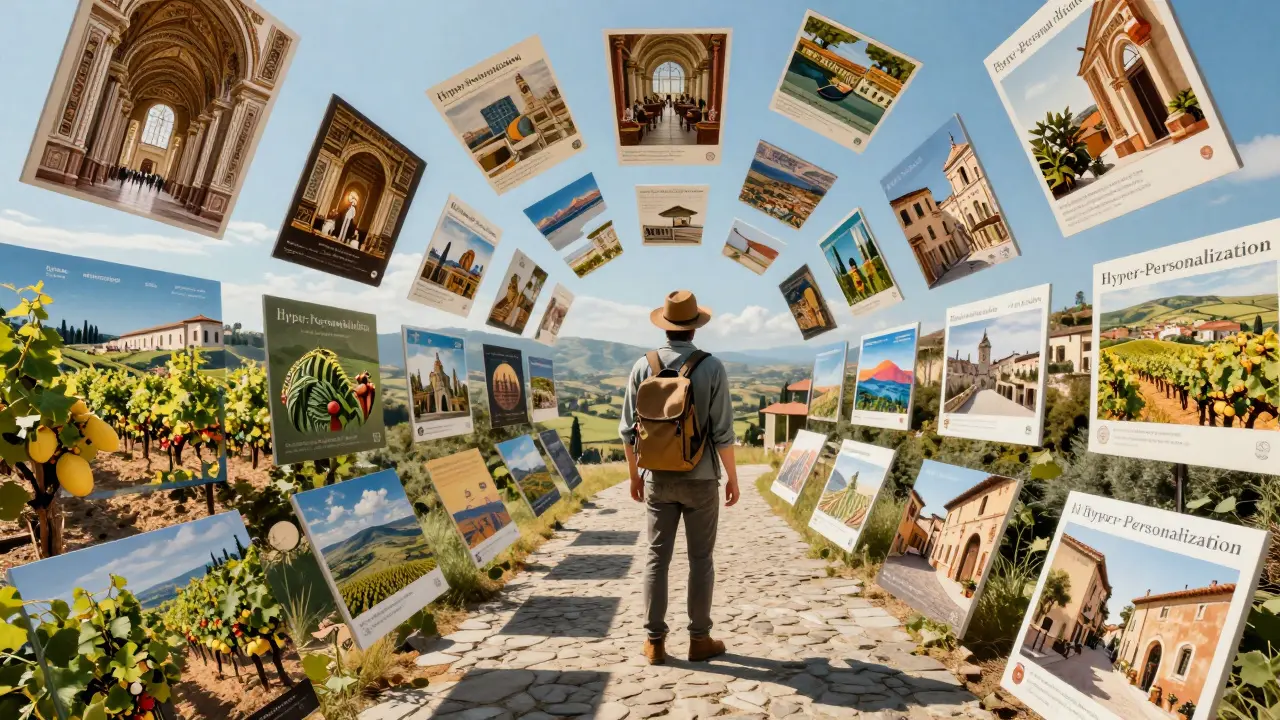
For decades, advertising was about the "average" customer. You built a persona, wrote one great headline, and hoped it hit the mark for a million people. With Generative AI, we have entered the era of the N=1 segment. Instead of one ad for a thousand people, we can now create a thousand ads for a thousand people.
Think about a luxury travel brand. Instead of a generic "Visit Italy" ad, the AI analyzes the user's recent interests-maybe they love Renaissance art and sustainable vineyards. Within milliseconds, the system generates a specific copy emphasizing the Uffizi Gallery and organic Tuscan estates. This isn't just a template; it's a unique piece of persuasive writing tailored to a specific psychological profile. When the copy speaks directly to a person's current mood and desire, conversion rates typically jump by 20% to 30% compared to static creative.
Scaling Creative Production Without Burnout
The biggest bottleneck in any agency is the "creative wall." Brainstorming sessions that take hours often result in three usable ideas. Now, ChatGPT acts as the ultimate mood board. By feeding the AI specific brand guidelines, past winning ads, and customer pain points, marketers can generate 50 distinct angles for a single product in seconds.
The real magic happens in A/B testing. In the old days, you'd test a blue button versus a red button. Now, you can test five different emotional hooks: one based on fear of missing out (FOMO), one based on aspirational luxury, one focused on pure utility, one using humor, and one using social proof. Because the AI handles the drafting, the human's job shifts to curation and psychological auditing. You aren't the writer anymore; you're the editor-in-chief.
| Phase | Traditional Method | ChatGPT-Driven Method |
|---|---|---|
| Ideation | Hours of brainstorming/whiteboarding | Instant generation of 50+ diverse angles |
| Drafting | Days to write multiple ad versions | Seconds to produce full copy sets |
| Testing | 2-3 variations due to time constraints | Hundreds of micro-variations (Dynamic Creative) |
| Iteration | Manual rewrites based on data | Instant pivot based on real-time performance |
Mastering the Brand Voice in an AI World
The biggest risk with AI is "beige content." If you just ask for a "catchy ad for shoes," you'll get a generic, soul-less response that sounds like every other brand on the internet. To avoid this, you need to treat the AI like a new employee who needs a detailed onboarding manual. This is where Prompt Engineering becomes a core business skill.
Instead of simple prompts, successful advertisers use "Brand DNA" documents. You feed the AI a list of banned words (e.g., "game-changer," "revolutionary"), a list of required emotional beats, and examples of the brand's most successful historical copy. By defining the persona-for example, "Write as a cynical but helpful expert in urban planning"-you move away from generic outputs. This ensures that while the AI provides the speed, the human provides the soul.
Integrating AI with Ad Delivery Platforms
Copy is only half the battle. The true power of Artificial Intelligence in advertising comes when it connects to the delivery platforms. We are seeing a deep integration between LLMs and Meta Ads and Google Ads. The AI doesn't just write the ad; it suggests which audience segment will respond best to which specific phrase.
For instance, a SaaS company might find that their "Efficiency" angle works perfectly for C-suite executives, while their "Ease of Use" angle converts better for mid-level managers. The AI identifies these patterns in the data and automatically swaps the copy in real-time. This creates a closed-loop system where the AI writes, the platform delivers, the data reports back, and the AI rewrites the next version to be even more effective.
The Ethical Minefield: Transparency and Trust
As we lean harder into AI, we hit a wall of trust. Consumers are becoming savvy to "AI-slop." There is a growing backlash against content that feels too perfect or obviously synthetic. The future of advertising isn't about hiding the AI; it's about using AI to be more human. This means using the time saved by automation to conduct real-world interviews, take authentic photos, and build genuine community relationships.
Moreover, the issue of Algorithmic Bias is a real danger. If an AI is trained on biased data, it might unintentionally exclude certain demographics from seeing high-value offers or use stereotypes in its copy. Human oversight is not just a "nice to have"-it's a legal and ethical requirement. Every AI-generated campaign must pass through a human filter to ensure it aligns with cultural nuances and brand safety standards.
Practical Steps for Implementing AI in Your Agency
If you are wondering where to start, don't try to automate your entire department overnight. Start with a small, low-risk project. Use the AI to generate 20 headlines for a single email subject line. Pick the best three, tweak them, and see if they outperform your manual ones. Once you trust the tool for small wins, move into full-scale campaign architecture.
Set up a centralized "Prompt Library" for your team. When one writer finds a prompt that consistently produces a high-converting hook for a specific industry, save it. This prevents every team member from reinventing the wheel and creates a standardized quality level across the agency. Treat your prompts as intellectual property; they are the blueprints for your success.
Will ChatGPT replace copywriters entirely?
No, but it will replace copywriters who only know how to write generic copy. The role is evolving from "writer" to "AI Creative Strategist." Humans are still needed for high-level strategy, emotional intelligence, and the final quality check that ensures a brand doesn't say something offensive or off-brand.
How do I stop AI ads from sounding robotic?
The secret is in the constraints. Avoid general prompts. Instead, give the AI a specific persona, a list of "forbidden words," and a target emotional state. Feeding it actual customer testimonials to mimic the natural language of your users is also one of the most effective ways to make AI copy feel authentic.
Is it legal to use AI-generated copy in ads?
Generally, yes, but copyright law is still catching up. In many jurisdictions, AI-generated content cannot be copyrighted. This means you might not "own" the specific string of words in an ad, but you own the campaign and the brand it promotes. Always check with a legal expert regarding specific trademark or copyright concerns in your region.
What is the best way to test AI-generated ads?
Use a "Champion vs. Challenger" model. Take your best performing human-written ad (the Champion) and pit it against three different AI-generated versions (the Challengers). Use a small budget to test for a week, then scale the winner. This allows you to quantify exactly how much value the AI is adding to your conversions.
Can ChatGPT help with ad images too?
Yes, through integration with DALL-E 3 or by writing highly detailed prompts for tools like Midjourney. It can help you brainstorm the visual metaphor for an ad-such as suggesting a "melting clock to represent time-saving software"-and then provide the exact prompt needed to generate that image.
I'm Felix Humphries, a seasoned professional in marketing with specialized expertise in online strategies. I foster compelling brand identities and drive growth through effective marketing solutions. I apply a data-driven approach to identify and track marketing trends, fueling impactful strategies. When I'm not strategizing, I enjoy turning my experiences into insightful articles about online marketing.