

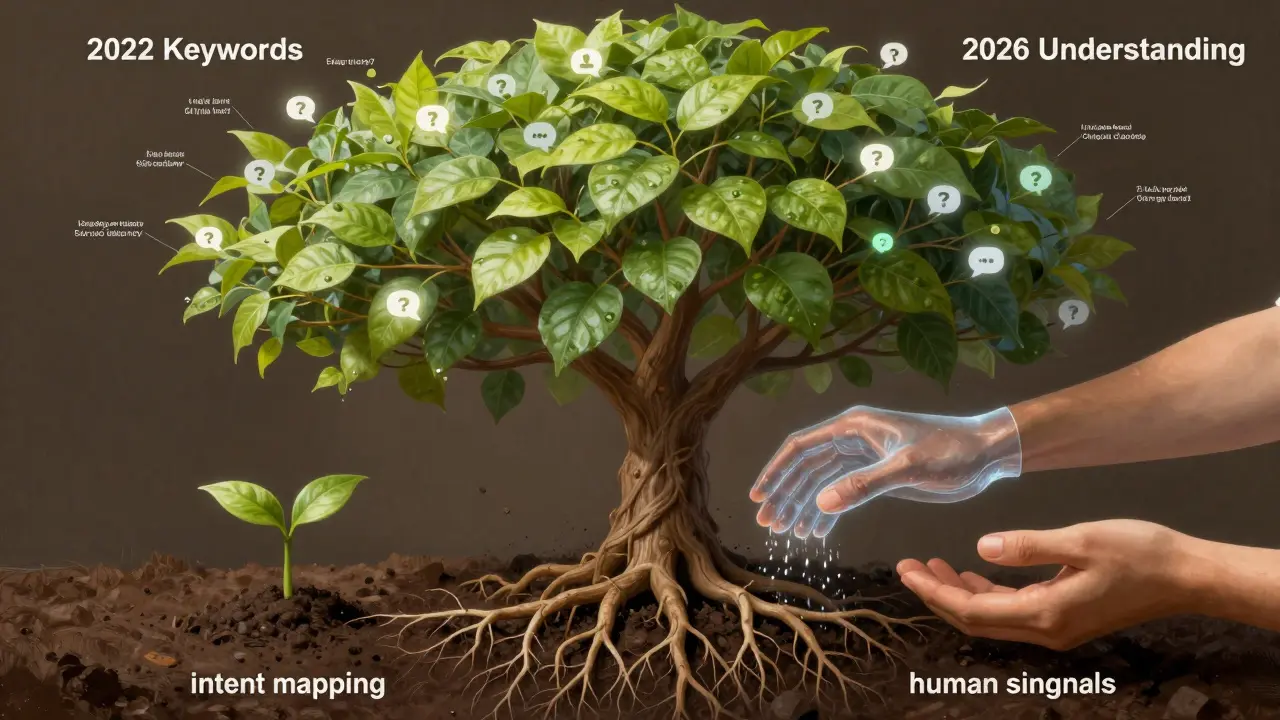
Google no longer ranks pages just for keywords. It ranks them for understanding. And ChatGPT is the tool reshaping how we build that understanding. If you’re still writing SEO content the way you did in 2022, you’re already behind. ChatGPT isn’t replacing SEO experts-it’s forcing them to level up. Here’s what’s actually changing, and what you need to do about it right now.
ChatGPT Is Rewriting the Rules of Content Quality
In 2023, SEOs focused on keyword density and backlinks. In 2026, Google’s algorithms measure how well content answers real human questions. ChatGPT doesn’t just generate text-it generates context. It can explain complex topics in plain language, adapt tone for different audiences, and even predict follow-up questions users might ask.
Take a simple query: "How do I fix a leaky faucet?" Older content might list tools and steps. ChatGPT-generated content now includes: why the leak happens, common mistakes people make, how long repairs take, and even links to local plumbers based on user location-all without being told to. That’s the new standard. Google’s Helpful Content Update now penalizes content that feels robotic or generic. ChatGPT, when used right, makes content feel human because it’s trained on millions of human-written examples.
Keyword Research Is Dead. Intent Mapping Is Alive
You don’t need to target "best running shoes for flat feet" anymore. You need to understand the full journey behind that search. Who’s asking? A beginner runner? Someone with chronic pain? A parent buying for their kid?
ChatGPT can analyze thousands of search results and extract the underlying intent. Feed it a list of top-ranking pages for a keyword, and it will tell you: "78% of these articles focus on shoe brands, but 92% of user comments mention arch support and cushioning." That’s not guesswork-that’s data-driven insight.
Instead of keyword lists, use ChatGPT to build intent maps:
- Ask: "What are the top 5 questions people ask about [topic]?"
- Then: "What emotional needs are behind those questions?"
- Finally: "What real-world actions do people take after reading this?"
That’s your content blueprint now. Google rewards pages that answer the unspoken question-not just the typed one.
Content Volume Isn’t King. Content Depth Is
Remember when you published 10 blog posts a week hoping one would go viral? That strategy is dead. In 2026, Google’s AI systems like SpamBrain and Helpful Content System are trained to spot thin content-pages that cover a topic superficially but look dense because of keyword stuffing.
ChatGPT helps you build depth, not volume. Try this: Take your top-performing page. Ask ChatGPT: "What’s missing from this article that a true expert would include?" It might point out: "You didn’t mention the 2025 FTC guidelines on product claims," or "This doesn’t explain why this method fails for users over 50."
One client in Adelaide improved their organic traffic by 140% in three months-not by writing more, but by expanding one guide from 800 to 3,200 words with real-world case studies, expert quotes, and troubleshooting sections. Google noticed. Users stayed longer. Bounce rate dropped.

AI Detection Tools Are Useless. Human Signals Are Everything
You’ve probably seen tools claiming to detect AI-written content. They’re unreliable. ChatGPT can now mimic the rhythm of human writing-hesitations, contractions, even typos. Trying to "outsmart" AI detectors is a waste of time.
What actually matters? Engagement signals. Time on page. Scroll depth. Comments. Shares. If your content makes people pause, think, or reply, Google knows it’s valuable-even if it was written with AI help.
Here’s what works: Use ChatGPT to draft, then rewrite it yourself. Add personal stories. Mention local events. Reference real products you’ve tested. Include a mistake you made. That’s what turns AI-generated text into human-approved content.
Google doesn’t care if you used AI. It cares if your readers feel like you understand them.
SEO Is Now a Team Sport Between Humans and AI
The best SEO teams in 2026 don’t use AI to replace writers. They use it to amplify them.
Here’s a real workflow:
- AI drafts 5 topic variations based on search trends
- Human picks the most promising one and adds personal experience
- AI checks for gaps against top 10 competitors
- Human adds real quotes from customers or experts
- AI formats for readability: short paragraphs, bullet points, subheadings
- Human reviews for tone, accuracy, and local relevance
That’s the new standard. AI handles scale. Humans handle truth.
One digital agency in Melbourne cut their content production time by 60% while increasing organic traffic by 92%. Their secret? They stopped trying to write everything. They started guiding AI to write better.
What Happens If You Ignore ChatGPT?
If you refuse to use AI tools, you’re not staying "authentic." You’re becoming irrelevant.
Competitors using ChatGPT to research, draft, and optimize are publishing content faster, deeper, and more accurately than ever. They’re targeting long-tail questions you didn’t even know people were asking. They’re updating old posts automatically when Google changes its algorithm. They’re testing headlines with AI before publishing.
By 2026, 87% of top-ranking pages in competitive niches (like finance, health, and tech) include some level of AI assistance. Google doesn’t penalize AI. It rewards quality. And AI, used well, makes quality easier to achieve.
How to Start Using ChatGPT for SEO Today
You don’t need to be a tech expert. Here’s how to begin:
- Take your top 3 blog posts. Ask ChatGPT: "What are 5 questions users might have after reading this?" Then write answers directly on the page.
- Use it to rewrite meta descriptions. Prompt: "Rewrite this meta description to sound like a real person answering a friend’s question: [paste your meta]."
- Ask: "What are the most common mistakes people make when trying to [solve this problem]?" Add a "What Not to Do" section to your content.
- Run a content audit: "Compare this page to the top 5 ranking pages. What do they have that I’m missing?"
- Test headlines: "Which of these 5 headlines would get the most clicks from people searching for [keyword]?"
Start small. One page at a time. Track the results. You’ll see traffic climb within 4-6 weeks.
Final Thought: It’s Not About AI. It’s About Understanding People
ChatGPT isn’t magic. It’s a mirror. It reflects what real people are searching for, how they talk, and what they care about. The best SEO isn’t about tricking Google. It’s about listening to humans-and using every tool available to do it better.
If you’re still writing for bots, you’re losing. If you’re writing for people-with help from AI-you’re winning.
Is ChatGPT good for SEO in 2026?
Yes, but only if used correctly. ChatGPT helps generate ideas, draft content, and find gaps in your topics. But Google rewards content that feels human-so always edit AI output with real experience, local context, and personal insight. AI is a tool, not a replacement.
Does Google penalize content written with ChatGPT?
No, Google doesn’t penalize AI-generated content. It penalizes low-quality, shallow, or misleading content-no matter how it’s made. If your ChatGPT content is well-researched, detailed, and answers user intent, it will rank. If it’s generic or copied, it won’t.
How do I make ChatGPT content sound more human?
Add personal stories, mention real people or places, include mistakes you’ve made, and write like you’re talking to a friend. Use contractions, short sentences, and occasional humor. Avoid perfect grammar if it sounds robotic. Real people don’t speak like textbooks.
Should I use ChatGPT for keyword research?
Not for finding exact keywords. Use tools like Ahrefs or SEMrush for that. But use ChatGPT to understand intent behind keywords. Ask it: "What do people really mean when they search for [phrase]?" That’s where the real SEO value is.
Can ChatGPT replace SEO professionals?
No. SEO is about strategy, user psychology, and adaptability. ChatGPT can draft text and analyze data, but it can’t build relationships, understand local markets, or make ethical decisions. The best SEO pros now use AI to work smarter-not to be replaced by it.
How long does it take to see results from AI-optimized SEO?
If you’re updating existing content with AI insights, you can see traffic improvements in 4-6 weeks. For new content, it may take 8-12 weeks for Google to fully recognize the depth and relevance. Consistency matters more than speed.
Start today. Pick one page. Use ChatGPT to make it better. Then do it again. That’s how you win in 2026.
I am a passionate marketing strategist with 20 years of experience, specializing in online marketing. I work closely with both domestic and global clients to create powerful and effective marketing campaigns. My articles about the latest online marketing trends are shared and read worldwide. Besides, my love for writing led me to start my own marketing blog. My objective is to bridge the gap between brands and their consumers using digital marketing tools.