

Quick Wins for Your Content Strategy
- Instant Ideation: Turn one core idea into ten different formats (email, LinkedIn post, Twitter thread, etc.).
- Rapid Research: Summarize long documents or find analogies to explain complex concepts.
- Drafting Speed: Move from a rough outline to a first draft in minutes, not hours.
- Repurposing: Convert a long-form YouTube script into a polished newsletter.
Mastering the Art of Prompt Engineering
Most people fail with AI because they give vague instructions. If you tell the AI to 'write a blog post about coffee,' you'll get a generic, boring piece of text. To get professional results, you need Prompt Engineering, which is the process of refining the input sent to an AI model to elicit the most accurate and high-quality response. Think of it as giving a detailed brief to a junior writer.
A winning prompt usually has four components: Role, Context, Task, and Format. Instead of a simple request, try this: "You are an expert B2B copywriter with 15 years of experience in SaaS. I am launching a new project management tool for remote creative agencies. Write a 500-word introductory email that focuses on reducing burnout. Use a helpful, empathetic tone and end with a clear call-to-action to book a demo. Format the output with a subject line and three optional variations."
By defining the role, you force the AI to draw from a specific subset of its training data. When you add constraints-like a word count or a specific tone-you eliminate the fluff. Have you noticed how the AI tends to use words like 'delve' or 'tapestry'? By telling it to "write in a conversational, punchy style and avoid corporate jargon," you strip away the robotic markers.

Building a Scalable Content Pipeline
The real magic happens when you stop treating ChatGPT as a one-off writer and start using it as a pipeline. This is where Content Automation comes in. Instead of asking for a full article, break the process into steps. First, ask it to generate a list of pain points your audience faces. Second, ask it to create a detailed outline based on the most pressing pain point. Third, have it write each section one by one.
This granular approach prevents the AI from losing the thread or becoming repetitive. For instance, if you're creating a series of guides for a fitness app, you can build a custom set of instructions (or a 'persona') that the AI remembers across different sessions. This ensures that your brand voice remains consistent whether you're writing a caption for Instagram or a detailed guide on macro-tracking.
| Phase | Manual Process | AI-Assisted Process | Time Saved |
|---|---|---|---|
| Ideation | 2-4 hours of brainstorming | 10 minutes of prompting | ~95% |
| Outlining | 1 hour of structuring | 5 minutes of refinement | ~90% |
| First Draft | 4-8 hours of writing | 30 minutes of generation | ~85% |
| Editing | 1-2 hours of polishing | 1 hour of human refining | ~10% |
Avoiding the AI Content Trap
There is a huge risk in relying too heavily on Generative AI, which is AI capable of creating new content, such as text, images, or audio, based on patterns learned from existing data. The biggest trap is the 'averageness' of the output. Because these models predict the next most likely word, they often produce content that is technically correct but completely devoid of unique insight or a strong opinion.
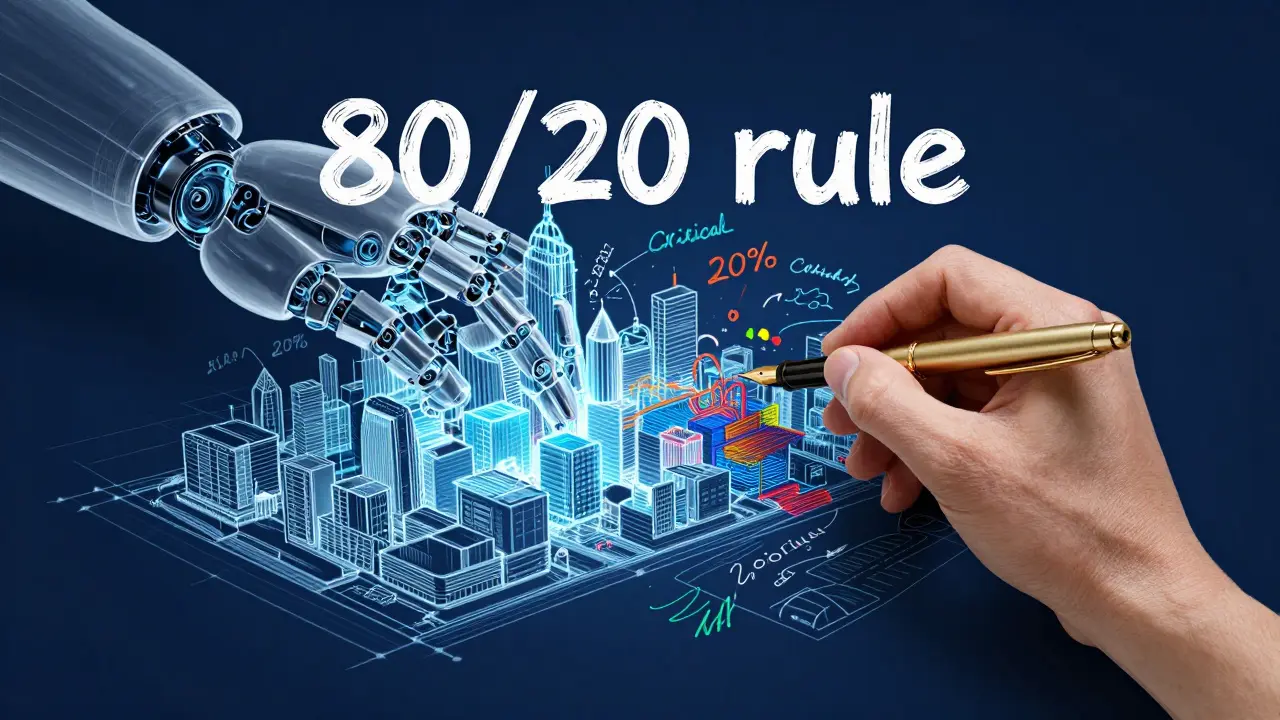
To avoid this, apply the 80/20 rule: let the AI do 80% of the heavy lifting (research, structure, first draft) and you provide the critical 20% (personal anecdotes, unique case studies, and final fact-checking). If you're writing about the future of urban planning in Australia, the AI can tell you the general trends, but it can't tell you how the traffic actually feels on the South Eastern Freeway during rush hour. That's the 'human' element that earns trust and drives conversions.
Another pitfall is the 'hallucination' effect. AI can confidently state facts that are completely made up. Always verify names, dates, and specific statistics. Use the AI to find the general direction, but use primary sources to lock in the truth. A quick tip: ask the AI to "provide the logic behind this claim" or "cite the general principle this is based on" to help you spot errors more easily.
Integrating AI with Other Digital Tools
ChatGPT doesn't live in a vacuum. To truly revolutionize your work, you need to connect it with other Digital Marketing tools. For example, you can use it to analyze data from Google Analytics. Paste your top-performing page titles into the chat and ask, "Based on these high-performing headlines, what common psychological triggers are working for my audience? Give me five new headline ideas using these same triggers."
You can also bridge the gap between content and SEO. While the AI isn't a live keyword research tool, it's brilliant at clustering. If you have a list of 50 keywords, ask it to "group these into five logical topical clusters and suggest a pillar page title for each." This turns a messy spreadsheet into a strategic content map in seconds.
For those using social media, the transition from a long-form article to short-form snippets is where AI shines. Try a prompt like: "I've written this article on AI content. Please extract three contrarian takes from the text and turn them into a provocative Twitter thread designed to spark a debate." This maximizes the value of every single piece of content you produce.
Will using ChatGPT hurt my SEO rankings?
Google has explicitly stated that they reward high-quality content, regardless of how it's produced. The key is that the content must be helpful, original, and provide actual value to the user. If you simply copy-paste raw AI output, you risk being flagged for low-quality content. But if you use AI to structure and draft, then add your own expertise and editing, your rankings should be fine.
How do I stop ChatGPT from sounding like an AI?
The best way is to give it a very specific voice profile. Tell it to avoid adjectives like 'comprehensive,' 'revolutionary,' and 'cutting-edge.' Ask it to use shorter sentences, include rhetorical questions, and use a 'no-nonsense' tone. Providing examples of your own previous writing and asking it to 'analyze this style and mimic the cadence' also works wonders.
Can ChatGPT do real-time research?
Depending on the version you use, ChatGPT can browse the web to find current information. However, it can still miss nuances or misinterpret a source. Always treat AI-generated 'facts' as a starting point and verify them with a quick search or by visiting the official source page before publishing.
What is the best way to organize prompts for a team?
Create a 'Prompt Library' in a shared document or tool like Notion. Instead of just saving the prompt, save the 'Input' and the 'Expected Output.' This helps team members understand exactly how to tweak the prompt for different projects and ensures a consistent brand voice across the whole company.
Is ChatGPT better than other AI writers?
It depends on the task. ChatGPT is generally the best for creative brainstorming and flexible formatting. Other tools might be better for highly structured SEO templates or purely data-driven reports. The best approach is often to use a combination of tools-using one for ideation and another for final polish or fact-checking.
Next Steps for Your Workflow
If you're feeling overwhelmed, don't try to automate everything at once. Start with a 'Low-Hanging Fruit' approach. Pick one task-maybe it's your weekly newsletter or your LinkedIn updates-and commit to using a structured prompt for that specific task for one month. Once you see the time savings, expand into outlining and research.
For those who find the AI output still feels 'off,' try the 'Inverse Prompting' technique. Paste a piece of writing you absolutely love and ask the AI: "Analyze the tone, structure, and pacing of this text. Write a prompt that would allow you to recreate this exact style for a different topic." This removes the guesswork and gives you a precise formula for quality.
As a seasoned professional in the field of marketing, I've built a wealth of knowledge and expertise over the years. Currently, I work in a reputed firm where my key focus is on online marketing strategies. In my free time, I enjoy sharing my insights and experience through my blog that is dedicated to online marketing. I also love exploring innovative ways to connect brands with their target demographics online.