
Picture this: You have a fantastic product. Maybe it’s handmade soap, a brilliant SaaS tool, or a consulting service that solves a real pain point. But nobody knows you exist. You post on social media once a week, run an ad here and there, and wonder why your bank account isn’t reflecting the effort. Sound familiar? That is the classic digital marketing trap. It feels like shouting into a void because you are treating every channel as a separate silo rather than parts of one conversation.
Digital marketing is not magic. It is simply the practice of connecting with people where they already spend their time-online-and giving them a reason to care about what you offer. For beginners, the landscape looks like a tangled web of acronyms: SEO, PPC, CTR, ROI, KPIs. It is overwhelming. But if you strip away the jargon, it boils down to three things: attention, trust, and action. This guide breaks down those concepts into steps you can actually take today, without needing a massive budget or a degree in data science.
The Core Pillars of Online Visibility
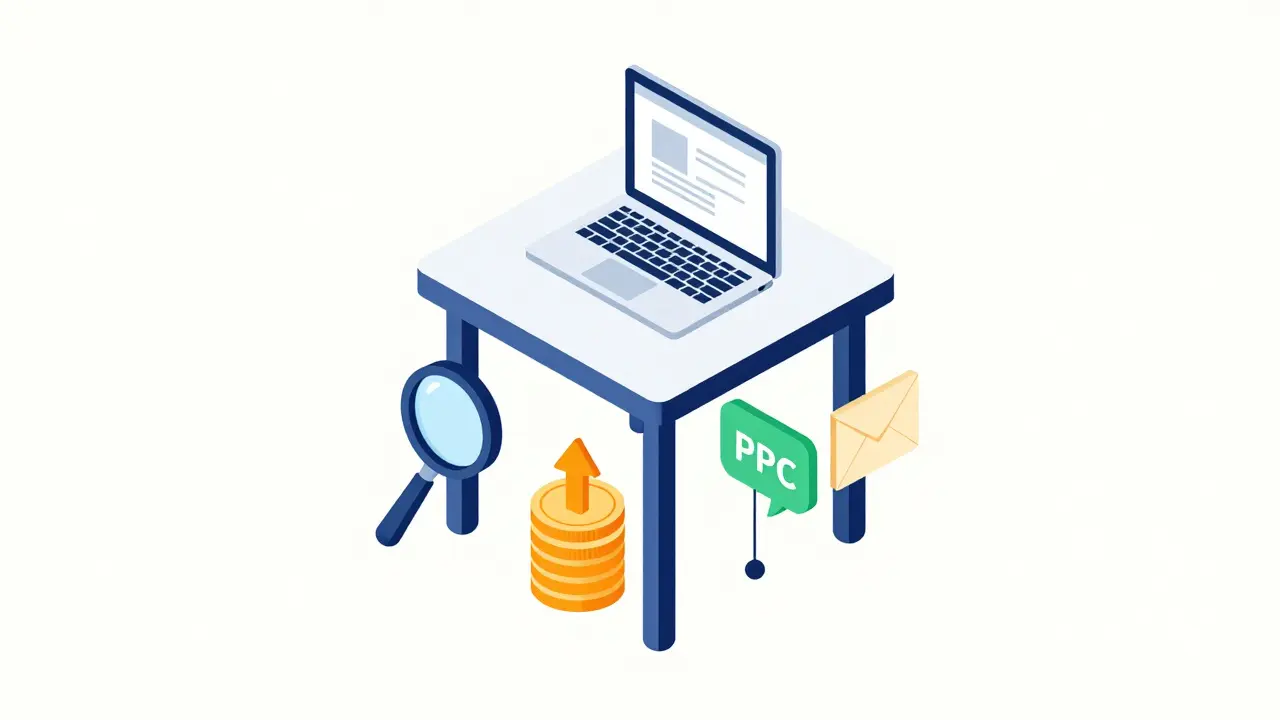
Before you write a single tweet or buy an ad, you need to understand the four main engines that drive traffic. Think of these as the legs of a table. If one is short, the whole thing wobbles. Most beginners obsess over social media (one leg) while ignoring search engines (another leg), leaving them unstable.
- Search Engine Optimization (SEO) is the process of optimizing your website to rank higher in organic search results like Google. This is long-term play. It takes months to build authority, but it pays dividends for years. When someone searches "best running shoes for flat feet," you want to be there. SEO relies on high-quality content, fast loading speeds, and technical health.
- Pay-Per-Click Advertising (PPC) is a model where advertisers pay a fee each time one of their ads is clicked. Unlike SEO, this is instant. You can launch a campaign on Google Ads or Meta Ads today and get traffic tomorrow. The catch? The moment you stop paying, the traffic stops. Use PPC for testing messages or capturing immediate demand, not as a permanent crutch.
- Social Media Marketing is using platforms like Instagram, LinkedIn, and TikTok to build community and brand awareness. This is about relationship building. People do not buy from faceless corporations; they buy from humans. Social media lets you show the behind-the-scenes, answer questions, and humanize your brand.
- Email Marketing is direct communication with subscribers who have opted in to hear from you. This is your owned audience. Algorithms change, platforms ban accounts, but your email list stays yours. It has the highest return on investment (ROI) of any channel because you are talking directly to interested people.
Notice how these connect? Social media drives people to your blog (SEO). Your blog captures emails (Email Marketing). Email nurtures leads until they are ready to buy via a targeted ad retargeting campaign (PPC). They work together.
Knowing Who You Are Talking To
The biggest mistake beginners make is trying to sell to everyone. "Everyone" is not a target audience. If you try to speak to everyone, you speak to no one. You need to define your buyer persona. This is a semi-fictional representation of your ideal customer based on market research and real data about your existing customers.
Let’s say you sell premium coffee beans. Your audience isn’t just "coffee drinkers." Is it the busy professional who needs caffeine before a 9 AM meeting? Or the weekend hobbyist who enjoys brewing pour-over methods? These two people have different needs, use different language, and hang out in different corners of the internet.
Create a simple profile for your primary persona:
- Name: Give them a name, like "Corporate Carl" or "Hobbyist Hannah."
- Pain Points: What keeps them up at night? Carl worries about energy crashes. Hannah worries about bean freshness.
- Goals: What do they want to achieve? Carl wants productivity. Hannah wants a ritual.
- Online Behavior: Where do they scroll? Carl checks LinkedIn and news sites. Hannah watches YouTube tutorials and follows Instagram food bloggers.
When you know this, your content becomes laser-focused. You stop guessing and start solving specific problems. This specificity builds trust faster than generic slogans ever could.
Content That Converts: Quality Over Quantity
There is a myth that you need to post daily to succeed. That is false. Posting low-value content daily hurts your brand more than posting high-value content weekly. Content marketing is about providing value upfront. You give useful information, entertainment, or inspiration for free, and in exchange, you earn the right to ask for something later.
Focus on creating pillar content. These are comprehensive guides that cover a topic in depth. For example, instead of ten short tweets about "how to bake bread," write one ultimate guide titled "The Complete Beginner’s Guide to Artisan Bread at Home." Link to smaller, related posts within that guide. This structure helps search engines understand your expertise and keeps readers on your site longer.
Use the E-E-A-T framework as your quality check:
- Experience: Have you used the product/service yourself? Share personal anecdotes.
- Expertise: Do you have credentials or deep knowledge? Cite sources and data.
- Authoritativeness: Is your site recognized by others? Get backlinks from reputable sites.
- Trustworthiness: Is your site secure? Are your claims honest? Include clear contact info and privacy policies.
Google’s algorithms are increasingly sophisticated at detecting thin content. If your page doesn’t fully answer the user’s query, it will drop in rankings. Aim to be the best resource on the internet for that specific question.
| Content Type | Best For | Effort Level | Longevity |
|---|---|---|---|
| Blog Posts | SEO, Education | Medium | High (Evergreen) |
| Social Media Updates | Awareness, Engagement | Low | Very Low (Hours/Days) |
| Email Newsletters | Nurturing, Sales | Low-Medium | Medium (Archiveable) |
| Video Tutorials | Demonstration, Trust | High | High (Evergreen) |
Measuring What Matters
If you cannot measure it, you cannot improve it. However, beginners often fall into the vanity metric trap. Likes, followers, and page views feel good, but they do not pay the bills. You need to track metrics that tie directly to business outcomes.
Start with these key performance indicators (KPIs):
- Conversion Rate: The percentage of visitors who take a desired action (buy, sign up, download). If you have 1,000 visitors and 10 sign ups, your conversion rate is 1%. Industry averages vary, but anything below 2% usually indicates a problem with your offer or landing page.
- Cost Per Acquisition (CPA): How much you spend to get one paying customer. If you spend $100 on ads and get 5 customers, your CPA is $20. Compare this to your profit margin. If your product costs $15 to sell, you are losing money.
- Bounce Rate: The percentage of visitors who leave after viewing only one page. A high bounce rate (>70%) suggests your content didn’t match their intent or your site loads too slowly.
- Return on Ad Spend (ROAS): Revenue generated for every dollar spent on advertising. A ROAS of 4:1 means you made $4 for every $1 spent. Most businesses aim for at least 3:1 to break even after overhead.
Set up Google Analytics 4 (GA4) is the latest version of Google's free analytics platform that tracks website and app activity. It provides detailed insights into user behavior. Install the tracking code immediately. Without data, you are flying blind.

A Simple 30-Day Action Plan
Overwhelm is the enemy of execution. Do not try to master all channels at once. Pick one primary channel and one secondary channel. Here is a realistic 30-day plan to get started:
- Week 1: Foundation. Audit your current online presence. Claim your Google Business Profile if you have a local component. Set up GA4. Define your buyer persona. Write down your unique value proposition (why should someone buy from you instead of competitors?).
- Week 2: Content Creation. Identify five common questions your customers ask. Write one comprehensive blog post answering each. Optimize titles and headers for keywords. Create simple graphics for social media sharing.
- Week 3: Distribution. Publish the posts. Share them on your chosen social platforms. Send them in an email newsletter (if you have a list) or create a lead magnet (like a checklist) to capture emails for future newsletters.
- Week 4: Analysis & Iteration. Review GA4 data. Which post got the most traffic? Which had the lowest bounce rate? Double down on that topic. Adjust headlines or images for underperforming posts. Plan next month’s content based on what worked.
Consistency beats intensity. Doing a little bit every day is better than burning out with a huge push once a month. Digital marketing is a marathon, not a sprint.
Common Pitfalls to Avoid
Even with a plan, mistakes happen. Watch out for these frequent errors:
- Ignoring Mobile Users: More than half of all web traffic comes from mobile devices. If your site is not responsive (adapts to screen size), you are losing potential customers instantly. Test your site on a phone regularly.
- Buying Followers: Never do this. Bot accounts do not buy products. They dilute your engagement rates and signal to algorithms that your content is irrelevant. Authentic growth is slow but sustainable.
- Skipping the Call to Action (CTA): People rarely guess what you want them to do. Tell them explicitly. "Sign up now," "Download the guide," "Call us today." Make buttons visible and contrasting.
- Neglecting Customer Service: Digital marketing brings people in, but poor service drives them away. Monitor comments and emails. Respond quickly and politely. One happy customer can refer five others.
Remember, technology changes. New apps emerge, algorithms update, trends fade. But human psychology does not change. People still seek solutions, trust recommendations, and respond to clear value. Master the fundamentals, stay adaptable, and focus on serving your audience genuinely.
How much does digital marketing cost for beginners?
You can start with zero budget using organic strategies like SEO and social media. However, allocating a small budget ($50-$100/month) for tools like email marketing software or boosted social posts can accelerate results. Paid advertising costs vary widely by industry but typically require a minimum of $10-$50/day to gather meaningful data.
How long does it take to see results from digital marketing?
Paid ads (PPC) can generate traffic immediately. Social media engagement may take weeks to build momentum. SEO and organic content marketing typically take 3 to 6 months to show significant traction as search engines crawl and index your content and build authority.
Do I need to be on every social media platform?
No. Being everywhere means being mediocre everywhere. Choose one or two platforms where your target audience spends time. B2B companies often succeed on LinkedIn, while visual brands thrive on Instagram or Pinterest. Focus your energy on mastering one channel before expanding.
What is the most important metric to track?
Revenue or Conversion Rate. While likes and shares are nice, they do not sustain a business. Focus on metrics that indicate progress toward your business goals, such as sales, lead form submissions, or newsletter sign-ups.
Can I do digital marketing alone?
Yes, many small business owners manage their own marketing initially. Start with foundational tasks like content creation and basic SEO. As you grow, consider outsourcing specialized tasks like paid ad management or graphic design to freelancers or agencies.
I'm a Marketing Expert with over a decade of experience in the industry. I specialise mainly in online marketing and have worked with numerous global brands to elevate their online presence, build their brand image, and increase their sales. My passion lies in creating meaningful and engaging campaigns that truly resonate with audiences. In my spare time, I enjoy sharing my knowledge and experiences through my blog where I primarily write about the latest trends and tricks in online marketing.