

You have a marketing plan. You have a budget. But you don't have enough hours in the day to write every email, caption, and blog post yourself. That gap is where ChatGPT fits in. It is not just a chatbot; it is a force multiplier for your team. By mid-2026, using generative AI in marketing isn't a futuristic experiment-it's standard practice. The question is no longer *if* you should use it, but *how* to do it without losing your brand voice or wasting money on generic output. This guide walks you through exactly that: practical, step-by-step ways to plug an LLM into your daily workflow.
Setting Up Your Foundation: Context Is King
The biggest mistake marketers make with OpenAI's language model is treating it like a search engine. You type "write a blog post about shoes," and you get... well, a blog post about shoes. It’s bland. It’s forgettable. To get high-quality results, you need to provide context. Think of the AI as a brilliant intern who knows everything about grammar but nothing about your company. You have to train them. Start by creating a "Brand Voice Document." This is a simple text file or note that defines:
- Tone: Are you witty? Professional? Empathetic? Urgent?
- Audience: Who are they? (e.g., "Busy CTOs," "New moms," "Budget-conscious students")
- Taboos: What words or phrases do you never use? (e.g., "synergy," "game-changer," "delve")
- Structure: Do you prefer short paragraphs? Bullet points? Storytelling arcs?
Step 1: Ideation and Content Planning
Before you write a single word, you need ideas. Brainstorming can be exhausting. An LLM excels at volume and variety. Use it to break writer's block. Prompt Strategy: Instead of asking for "blog ideas," ask for angles. Try this:
"We sell organic coffee beans. Our audience is remote workers who value productivity. Give me 10 blog post titles that focus on the connection between caffeine quality and deep work. Avoid generic health benefits. Make them catchy and SEO-friendly."The AI will generate options quickly. Scan them. Pick the three best ones. Now, ask for outlines for those specific titles. This iterative process-generate, filter, refine-is faster than staring at a blank page.
Step 2: Drafting High-Quality Copy
Once you have an outline, it’s time to draft. Don’t ask the AI to write the whole article at once. It loses coherence over long texts. Break it down section by section. The "Skeleton" Method: 1. Paste your outline. 2. Ask the AI to write only the introduction. 3. Review it. Does it sound like you? If not, give feedback: "Make it more conversational. Add a hook about morning routines." 4. Once satisfied, move to the next section. This approach gives you control. You are the editor; the AI is the drafter. Remember, the goal is not to replace human creativity but to accelerate execution. You still need to inject personal anecdotes, specific data points, and unique insights that the AI cannot know.
Step 3: Repurposing Content Across Channels
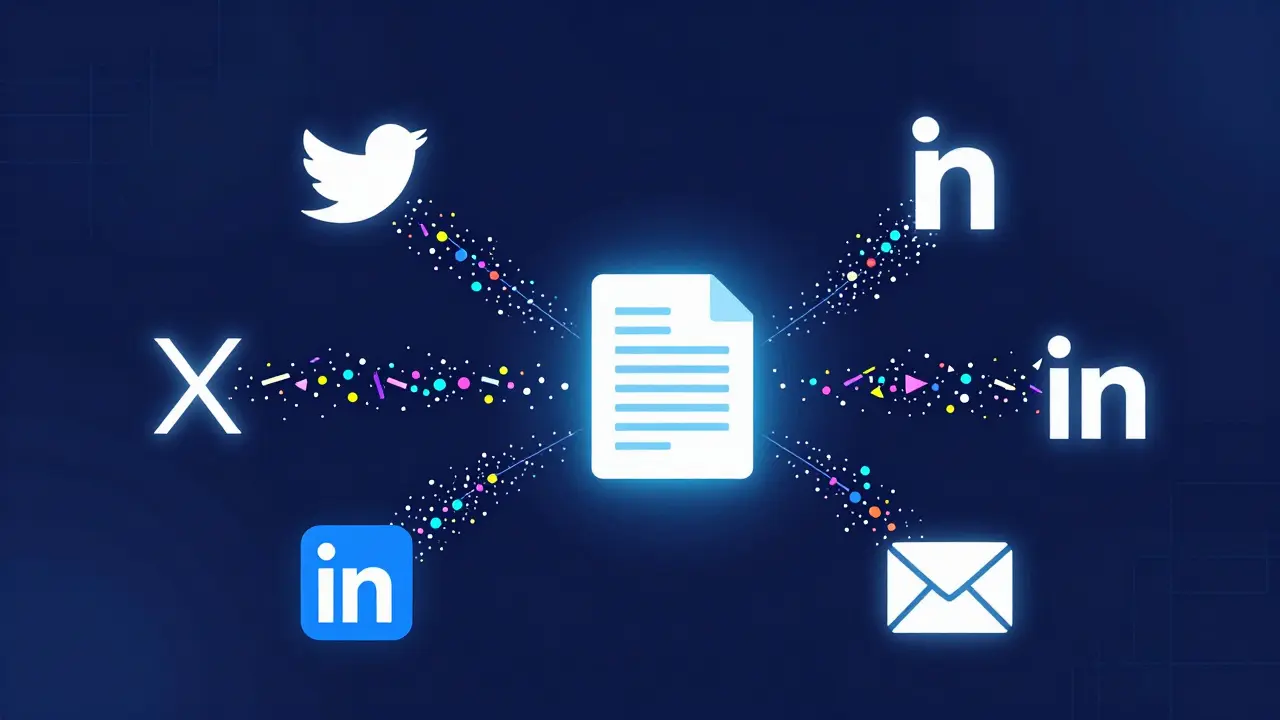
You wrote one great blog post. Now what? You need to turn it into:
- 5 Twitter/X threads
- 3 LinkedIn posts
- 1 newsletter summary
- 10 Instagram captions
"Summarize this article into a 280-character tweet thread. Focus on the top 3 takeaways. Use emojis sparingly."
"Rewrite the core argument of this article as a professional LinkedIn post targeting HR managers. Keep it under 150 words."
"Create 5 engaging questions based on this article to use in an Instagram story poll."This ensures consistency across platforms while adapting the tone and format for each channel’s specific audience expectations.
Step 4: Email Marketing and Personalization
Email open rates depend heavily on subject lines and relevance. AI can help you A/B test variations instantly. Subject Line Generator: Provide the email body and ask for 10 subject line variations categorized by style: Curiosity, Benefit-driven, Urgency, and Personal. For segmentation, if you have customer data (anonymized), you can ask the AI to suggest personalized opening lines. For example:
"Write an opening paragraph for a welcome email to a new subscriber who downloaded our 'SEO Checklist.' Reference the checklist and offer a related tip."This level of personalization at scale was previously impossible without expensive software. Now, it’s accessible to small teams.

Step 5: SEO Optimization
Search engines prioritize helpful, comprehensive content. AI can help you ensure you’re covering all bases. Keyword Integration: After drafting, paste your text along with your target keywords. Ask:
"Analyze this text for keyword density. Suggest natural places to include the phrase 'affordable digital marketing tools' without sounding spammy."Meta Descriptions and Titles: Ask the AI to generate 5 meta descriptions under 160 characters that include the primary keyword and a clear call to action. Choose the one that best matches your intent.
| Task | Manual Time Estimate | AI-Assisted Time Estimate | Quality Control Needed |
|---|---|---|---|
| Brainstorming 10 Blog Ideas | 1-2 Hours | 10 Minutes | High (Filtering) |
| Drafting a 1,500-word Article | 3-4 Hours | 45 Minutes | Critical (Fact-checking & Tone) |
| Creating Social Media Variations | 1 Hour | 15 Minutes | Medium (Platform Nuances) |
| Writing Email Subject Lines | 30 Minutes | 5 Minutes | Low (A/B Testing) |
Common Pitfalls and How to Avoid Them
Using AI is powerful, but it comes with risks. Here’s how to stay safe and effective. Hallucinations: LLMs can invent facts. Never trust AI-generated statistics, quotes, or legal advice. Always verify claims against primary sources. If you mention a study, find the original paper. Generic Voice: If your content sounds like everyone else’s, you lose differentiation. Inject your personality. Add stories from your experience in Adelaide or elsewhere. Use specific examples from your industry. Over-Automation: Don’t set it and forget it. Human oversight is non-negotiable. Review every piece of content before publishing. Check for clarity, accuracy, and brand alignment. Data Privacy: Never input sensitive customer data, proprietary strategies, or confidential financial information into public AI models. Use anonymized data or enterprise-grade solutions with strict privacy controls.
Measuring Success
How do you know if AI is helping? Track these metrics:
- Content Output Volume: Are you producing more pieces per week?
- Time Saved: Calculate hours spent on drafting vs. editing.
- Engagement Rates: Monitor clicks, shares, and comments. If engagement drops, your voice might be too diluted.
- Conversion Rates: Ultimately, does the content drive actions? If yes, the strategy is working.
Is ChatGPT free for commercial use?
OpenAI offers both free and paid tiers. For commercial marketing use, especially involving sensitive data or high-volume generation, a paid subscription (like Plus or Pro) is recommended for better performance, priority access, and enhanced features. Always check the latest terms of service regarding copyright and usage rights.
Will Google penalize AI-written content?
Google has stated that it does not penalize content simply because it is AI-generated. However, it does penalize low-quality, unhelpful, or spammy content. If your AI content is thin, repetitive, or lacks original insight, it will rank poorly. Focus on E-E-A-T (Experience, Expertise, Authoritativeness, Trustworthiness) by adding human value and verification.
How do I maintain my brand voice with AI?
Create a detailed brand voice guide and feed it to the AI at the start of every session. Provide examples of your best past content. After generating drafts, edit them to add personal anecdotes, specific terminology, and unique perspectives. The AI provides the structure; you provide the soul.
Can ChatGPT replace a copywriter?
Not entirely. While AI can draft content quickly, it lacks true creativity, emotional intelligence, and strategic thinking. It works best as a tool for professional copywriters to speed up their workflow, handle repetitive tasks, and overcome writer's block. Human oversight remains essential for high-stakes communications.
What are the best prompts for social media marketing?
Effective prompts specify platform, tone, length, and goal. Example: "Write a LinkedIn post for startup founders about overcoming burnout. Use a professional yet empathetic tone. Include 3 bullet points and a question to encourage comments. Keep it under 150 words." Specificity leads to better results.
As a seasoned professional in the field of marketing, I've built a wealth of knowledge and expertise over the years. Currently, I work in a reputed firm where my key focus is on online marketing strategies. In my free time, I enjoy sharing my insights and experience through my blog that is dedicated to online marketing. I also love exploring innovative ways to connect brands with their target demographics online.