
Twitter isn’t just a platform for tweets anymore. It’s a live newsroom, a customer service desk, a viral content engine, and a 24/7 conversation hub. And right now, the people who are winning on Twitter aren’t just posting more-they’re posting smarter. Enter ChatGPT. Not as a tool to write tweets for you, but as the hidden engine turning casual users into social media powerhouses.
Twitter’s biggest problem isn’t noise-it’s consistency
Most brands and creators struggle with one thing: showing up every day. You’ve seen it. The account that posts three times in a week, then goes silent for ten days. The influencer who drops a viral thread and then disappears. Twitter rewards rhythm. It rewards frequency. And it punishes inconsistency.
ChatGPT doesn’t get tired. It doesn’t burn out. It doesn’t need coffee. You can feed it your brand voice, your past top-performing tweets, your audience’s pain points-and it will generate fresh, on-brand content every single day. No more staring at a blank text box at 11 p.m. wondering what to say.
Take a small e-commerce store selling eco-friendly water bottles. Before ChatGPT, they posted twice a week. After using it to generate 30 tweet ideas a week, they started posting daily. Engagement jumped 217% in six weeks. Not because their product changed. Because their presence did.
ChatGPT turns replies into relationships
Twitter is one of the few platforms where brands can actually talk to customers in real time. But most companies treat replies like chores. They use canned responses. They delay. They ignore.
ChatGPT changes that. You can train it to respond to common questions in your tone. Need to answer ‘How do I reset my password?’ or ‘Do you ship to Canada?’ or ‘Why is my order late?’-it handles those instantly. And it doesn’t sound robotic. Not if you feed it real examples of how your team talks.
A customer service team at a SaaS company used ChatGPT to draft replies to 80% of their DMs. They still reviewed each one, but their response time dropped from 12 hours to 47 minutes. Customer satisfaction scores went up. And here’s the kicker: users started tagging them in tweets saying, ‘You guys respond so fast!’
That’s not automation. That’s humanization at scale.
Threads aren’t written-they’re built
Twitter threads are the new blog posts. And they’re the most powerful way to get reach, backlinks, and followers. But writing a good thread? It’s hard. You need structure. You need hooks. You need a flow that keeps people scrolling.
ChatGPT can take a single idea-like ‘Why most people fail at saving money’-and turn it into a 12-tweet thread with a strong opener, three pain points, two solutions, and a call to action. You just paste the core idea, and it gives you a draft. Then you tweak it. Add your story. Add your humor. Add your personality.
One marketer used this method to turn a 30-minute brainstorm into a thread that got 1.4 million impressions. It didn’t have fancy graphics. It didn’t tag influencers. It just had clear, relatable, well-structured points-crafted by AI, polished by a human.

It’s not about replacing humans. It’s about amplifying them.
Some people say, ‘If you use AI to write tweets, you’re losing your voice.’ That’s true-if you copy-paste without editing. But that’s like saying if you use a calculator, you’re losing your math skills.
ChatGPT is your co-writer. Your idea generator. Your first draft machine. You still control the tone. You still pick the best lines. You still decide what to post. But now you’re not starting from zero every time.
Think of it like a graphic designer using Photoshop. They don’t paint every pixel by hand. They use tools to speed up the process so they can focus on the creative decisions. That’s exactly what ChatGPT does for Twitter.
Here’s a real workflow that works:
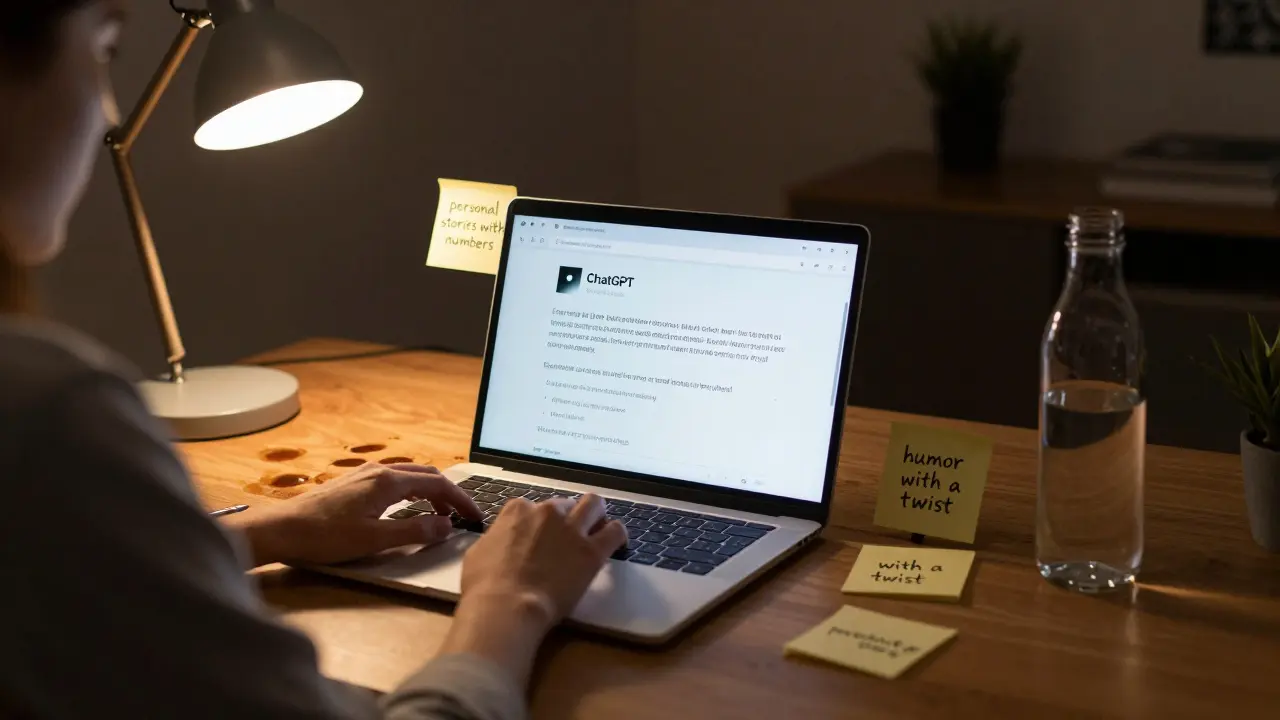
- Every Sunday, dump your top 5 tweets from last week into ChatGPT and ask: ‘What patterns do you see in these?’
- It will tell you: ‘Your audience responds best to personal stories with numbers’ or ‘Humor with a twist gets 3x more likes.’
- Use that insight to generate 10 new tweet ideas for the week.
- Pick 3 to post. Add your voice. Post.
That’s it. No complex software. No subscriptions. Just you, your brain, and a tool that never sleeps.
What most people get wrong about AI on Twitter
People think ChatGPT is for spamming. For posting the same thing 10 times. For buying followers. That’s not AI. That’s laziness.
The real power of ChatGPT on Twitter is in personalization. It learns your style. It remembers your past wins. It adapts to your audience’s mood. If your followers are mostly entrepreneurs, it won’t write memes about cats. It’ll write about burnout, pricing strategies, or cold outreach.
And it gets better over time. The more you correct it, the more it learns. After 20 tweaks, it starts anticipating your edits. After 50, it’s almost reading your mind.
One user trained ChatGPT on his 120 most successful tweets. Within a month, it was generating posts that outperformed his old ones by 40%. He didn’t change his content strategy. He just gave his brain a superpower.

Real results, not hype
Let’s get specific.
Here’s what actual users have done with ChatGPT on Twitter in 2025:
- A freelance copywriter went from 500 to 18,000 followers in 90 days by posting one tweet a day-each one crafted with ChatGPT and edited for personality.
- A local bakery posted daily tips on ‘How to make sourdough at home’ using AI-generated drafts. They sold out of their baking class three weeks early.
- A nonprofit working with homeless youth used ChatGPT to write compassionate replies to DMs asking for help. They doubled their donations in four months.
These aren’t tech bros with six-figure budgets. These are regular people using a free tool to do what used to take hours.
How to start today (no fluff)
You don’t need a team. You don’t need a budget. You don’t need to learn Python.
Here’s how to begin:
- Go to chat.openai.com (free version works).
- Type: ‘I run a [your business or niche]. Here are my top 5 tweets from the last month: [paste them]. What do they have in common?’
- Then ask: ‘Generate 10 tweet ideas based on these patterns, written in my voice.’
- Pick one. Edit it. Post it.
- Repeat tomorrow.
That’s it. No apps. No tools. Just you and ChatGPT.
The people who will dominate Twitter in 2026 aren’t the ones with the most followers. They’re the ones who show up consistently. They’re the ones who listen. They’re the ones who respond. And now, thanks to ChatGPT, they’re the ones who don’t have to burn out to do it.
Twitter rewards action. Not perfection. ChatGPT gives you the fuel. You still have to press the gas.
What’s next for AI on Twitter?
Twitter’s API is now open again. Third-party tools are popping up that let you schedule AI-generated tweets, auto-reply to keywords, and even analyze which tweets get the most engagement. But the real advantage won’t be in the tools-it’ll be in the people who use them wisely.
AI won’t replace Twitter users. It will replace the users who refuse to adapt.
The next big thing isn’t a new feature. It’s a new mindset: use AI to do the grunt work, so you can do the human work-connecting, caring, and creating.
I am Orlando Beauchamp, a marketing maven with a knack for digital strategies. My expertise lies in creating engaging content that drives brand growth and fosters customer relationships. I've devoted my career to exploring the nuances of online marketing, with a particular focus on social media and SEO. I love to share my insights by writing about the latest trends and techniques in online marketing. Through my articles, I aim to help businesses of all sizes tap into the immense potential of the digital world.