

Most marketers are still treating AI like a fancy autocomplete tool. They ask it to write a few social media captions or a generic email, and then they spend an hour fixing the robotic tone. But that is a massive waste of potential. We are well past the 'experiment' phase. In 2026, ChatGPT isn't just a tool for writing; it is the engine that allows a single person to do the work of an entire creative agency. If you are still using it just for drafting text, you are missing the actual shift in how customers buy products online.
Key Takeaways for Modern Marketers
- Shift from static content to dynamic, conversational customer journeys.
- Hyper-personalization at scale using real-time data integration.
- Significant reduction in production time for high-volume A/B testing.
- The move toward "AI-first" SEO and search generative experiences.
From Static Pages to Conversational Commerce
For decades, digital marketing was about the "funnel." You cast a wide net with an ad, landed people on a static page, and hoped they clicked a button. It was a guessing game. Now, ChatGPT is a large language model developed by OpenAI that enables natural, human-like conversations at scale. This changes the game because the funnel is no longer a series of pages; it is a conversation.
Imagine a customer visiting a skincare brand. Instead of browsing a list of 50 serums, they chat with an AI agent. The AI asks about their skin type, their current routine, and their budget. It then recommends the exact product based on those specific variables. This is conversational commerce. It removes the friction of searching and replaces it with a guided experience. When the AI handles the qualification process, the conversion rates don't just tick up-they skyrocket because the customer feels understood, not targeted.
The Death of the "Average" Buyer Persona
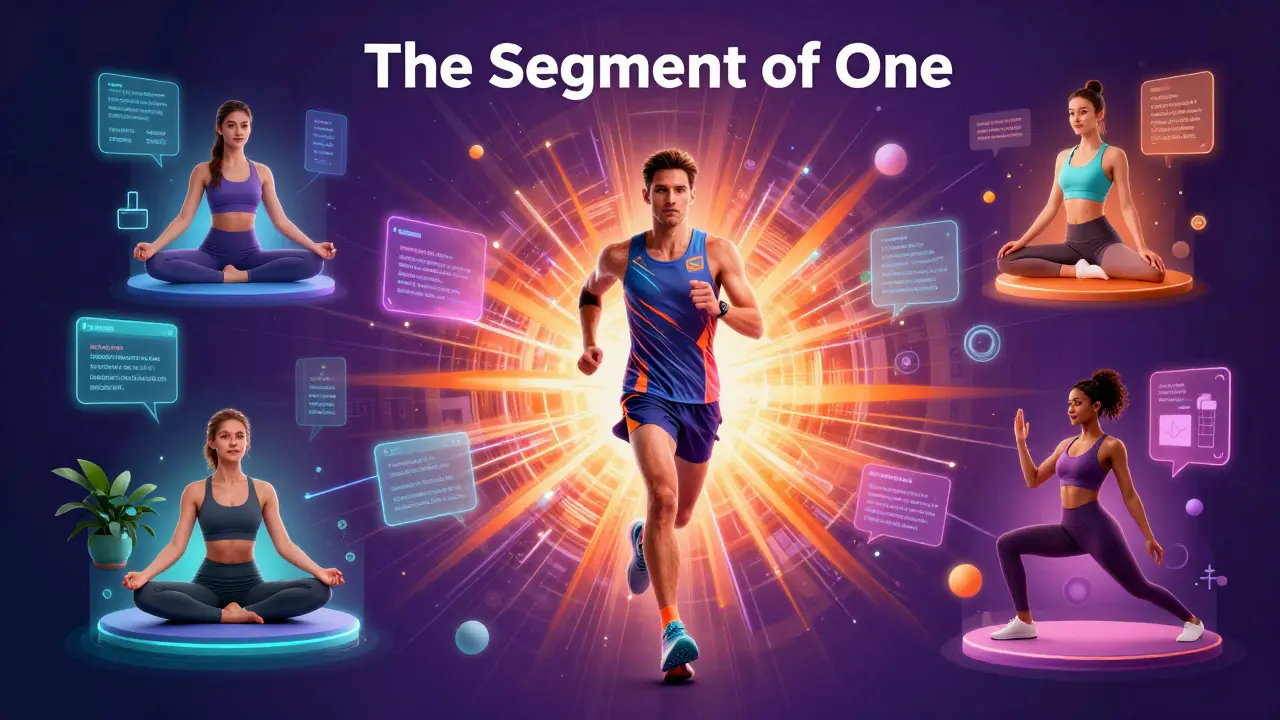
We used to create personas like "Marketing Mary, 35, lives in the suburbs, loves coffee." It was a useful generalization, but it was still a generalization. With AI, we can move toward a "Segment of One." By feeding Large Language Models (LLMs) specific customer data-like past purchase history and behavioral triggers-marketers can generate a thousand different versions of a single campaign, each tailored to a specific individual.
For example, if you run an e-commerce store for fitness gear, you don't need one "Spring Sale" email. You can have one version for the marathon runner who cares about durability, another for the yoga enthusiast who cares about sustainability, and a third for the gym-goer who wants the latest trends. The AI doesn't just change the name in the greeting; it changes the entire value proposition, the tone, and the call to action based on what that specific person actually cares about.
| Feature | Traditional Approach | ChatGPT-Powered Approach |
|---|---|---|
| Content Creation | Manual drafting and editing (Hours/Days) | Iterative prompting and refining (Minutes) |
| Customer Segmentation | Broad demographics (Age, Location) | Behavioral and psychographic precision |
| A/B Testing | Testing 2-3 variations of a headline | Testing 50+ variations simultaneously |
| Customer Support | Ticket-based or scripted bots | Context-aware, empathetic problem solving |
Scaling Content Without Losing the Soul
The biggest fear marketers have is that AI makes everything sound the same. If everyone uses the same prompts, every brand starts sounding like a polite corporate brochure. The secret to winning here is not "letting the AI write," but using AI as a sophisticated research and structuring tool.
The future belongs to those who use Prompt Engineering, which is the process of refining inputs to get the most accurate and creative outputs from an AI. Instead of asking "Write a blog post about SEO," a pro marketer asks the AI to analyze the top five ranking pages for a keyword, identify the content gaps, and then draft an outline that specifically addresses those missing points. They provide the AI with their brand's "voice guide"-including banned words, preferred sentence lengths, and specific anecdotes-to ensure the output feels human.
This allows for a volume of content that was previously impossible. You can turn one long-form whitepaper into 20 LinkedIn posts, 5 email newsletters, and 10 short-form video scripts in a fraction of the time. But the quality stays high because the human is acting as the creative director, not just a copy-paster.
Navigating the Shift in SEO and Search
We have to talk about how search is changing. For years, Search Engine Optimization (SEO) was about keywords and backlinks. But with the rise of Search Generative Experience (SGE), the goal is shifting. Google and Bing are now providing the answer directly on the search page using AI. If a user asks "What is the best CRM for a small business?" and the AI answers it immediately, the user might never click through to your website.
Does this mean SEO is dead? No. It means the strategy has to change. We are moving from "Keyword Optimization" to "Entity Optimization." You want your brand to be the entity that the AI trusts as the authority. This means getting mentioned in high-quality industry publications, having detailed reviews on third-party sites, and creating content that solves complex problems that a simple AI summary cannot handle. You need to provide deep, original insights-the kind of "lived experience" data that an AI cannot hallucinate.
The Integration of AI into the Tech Stack
The real power happens when ChatGPT moves out of the browser tab and into your software. Through API Integration, brands are connecting AI directly to their Customer Relationship Management (CRM) systems. Imagine a world where your CRM doesn't just tell you a lead is "warm," but automatically drafts a personalized follow-up email based on the specific objections the lead mentioned during a discovery call.
This level of automation handles the tedious parts of marketing-the data entry, the initial outreach, the basic scheduling-freeing up humans to do the things AI can't: building real relationships, strategizing high-level brand pivots, and understanding the emotional nuances of a cultural trend. The technology handles the distribution, while the human handles the direction.

Avoiding the AI Pitfalls
It is easy to get lazy with AI. The biggest mistake brands make is relying on "one-shot prompting." They enter a prompt once, take the first result, and publish it. This leads to a loss of brand trust. Customers are becoming incredibly good at spotting AI-generated fluff. If your content feels like it was written by a machine, your brand will feel like a machine.
Another risk is the "hallucination" factor. AI can confidently state facts that are completely wrong. In a regulated industry like finance or healthcare, this isn't just a mistake; it is a legal liability. Every single piece of AI-generated factual data must be verified by a human expert. The rule is simple: AI generates the draft, the human verifies the truth, and the editor polishes the emotion.
Will ChatGPT replace digital marketing agencies?
It won't replace agencies, but it will replace agencies that only provide commodity services. If an agency just writes basic blogs or manages simple ads, they are in trouble. However, agencies that pivot to become "AI Strategy Partners"-helping brands integrate AI into their workflows and focus on high-level creative strategy-will actually see their value increase. The focus is shifting from execution to orchestration.
Is AI-generated content penalized by Google?
Google has explicitly stated that they reward high-quality content, regardless of how it is produced. They don't penalize AI content simply for being AI. What they do penalize is low-effort content that doesn't provide value to the user. If you use AI to create helpful, accurate, and original content, you will rank. If you use it to spam the web with generic articles, you will be hit by their helpful content updates.
How can a small business start using AI without a big budget?
Start with the low-hanging fruit: customer service and content ideation. Use the free or low-cost versions of ChatGPT to build a set of "Brand Personas" that you can use to check all your copy for consistency. Create a library of prompts that work for your specific business. Instead of hiring a full-time copywriter, use AI to generate 10 variations of an ad, and then spend your small budget on a freelance editor to pick the winner and polish it.
What is the best way to maintain a human brand voice with AI?
Feed the AI your best-performing historical content. Tell it: "Analyze the tone, rhythm, and vocabulary of these three emails. This is our brand voice. Now, write a new email about [Topic] using this exact style." Also, always add personal anecdotes or current event references that the AI wouldn't know-those specific, human touches are what stop a reader from scrolling past.
Does AI make A/B testing more effective?
Absolutely. Traditionally, A/B testing was slow because humans could only write a few variations. Now, you can use AI to generate 20 different hooks based on 20 different psychological triggers (fear of missing out, desire for status, ease of use, etc.). By running these against each other, you find the winning angle much faster and with much more precision.
Next Steps for Your AI Transition
If you are feeling overwhelmed, don't try to automate everything at once. Start with one specific workflow. Maybe it is your weekly newsletter or your product descriptions. Run the AI version and the human version side-by-side for a month and track the conversion rates.
For those in B2B roles, focus on using AI to research your prospects' LinkedIn profiles and company reports to create highly specific outreach messages. For B2C, focus on creating a conversational AI bot that helps users find products. The goal isn't to remove the human from the loop, but to remove the boring parts of the loop so the human can focus on the actual art of marketing.
As a passionate marketer, I strive to connect businesses with their target audiences in creative ways. I specialize in developing and implementing digital and content marketing strategies. I am currently working as a Marketing Manager at a renowned firm. In my spare time, I love to share my knowledge about online marketing through my blog. I believe that continuous learning and sharing of knowledge are keys to growth.