

You stare at a blank screen. The deadline for your Q4 holiday campaign is tomorrow. You need fifty variations of ad copy, three distinct angles for social media, and a landing page headline that doesn't sound like every other competitor. Your brain feels like mush. Enter ChatGPT, an AI language model developed by OpenAI that generates human-like text based on prompts. It isn't magic, but if you treat it like a junior copywriter with infinite energy and zero judgment, it can cut your production time in half.
Most advertisers make the mistake of treating ChatGPT like a search engine. They type "write me an ad" and get generic fluff. The real power lies in iteration and specific context. This guide breaks down exactly how to leverage this tool to build better campaigns, not just faster ones. We will look at prompt structures, workflow integration, and where the AI still fails so you don't embarrass yourself in front of clients.
The Core Workflow: Context Before Content
Before you ask for a single word of copy, you must feed the model data. Think of ChatGPT as a mirror; it reflects what you give it. If you give it vague instructions, you get vague results. To get high-quality output, you need to provide four key pieces of information: the target audience, the unique selling proposition (USP), the tone of voice, and the desired action.
For example, instead of asking for "ads for running shoes," try this structure:
- Audience: Beginner runners aged 25-35 who are intimidated by gym culture.
- Product: CloudSoft Running Shoes with memory foam insoles.
- Benefit: Reduces knee pain during first mile runs.
- Tone: Encouraging, non-judgmental, slightly humorous.
- Format: Three Facebook ad headlines under 10 words each.
This level of detail forces the AI to narrow its probabilistic choices. Without it, you risk getting copy that sounds like it was written by a robot trying to sound human, which is ironic given the source. By defining constraints, you turn a generic generator into a targeted creative partner.
Crafting High-Converting Ad Copy
Once you have set the context, you can start generating variations. One of the biggest wins with ChatGPT is volume. Human copywriters often struggle to produce ten solid variations without burning out. ChatGPT does not care about burnout. You can ask it to generate twenty different hooks for the same product and then cherry-pick the best ones.
Try using the "AIDA" framework in your prompt. Ask the model to write copy following Attention, Interest, Desire, and Action steps. For instance: "Write five Instagram captions using the AIDA framework for our eco-friendly water bottles. Focus on the durability aspect." This structural guidance helps the AI organize its thoughts logically rather than rambling.
Another effective technique is role-playing. Tell ChatGPT to act as a specific persona. "Act as a skeptical customer who hates greenwashing. Write a response to our claim that our packaging is 100% biodegradable." This helps you identify potential objections before they appear in your comments section. It also generates authentic-sounding user-generated content (UGC) style copy that performs well on social platforms.

Visual Ideation and Creative Briefs
While ChatGPT cannot render images directly, it excels at describing them. Designers often suffer from brief fatigue-vague instructions lead to bad designs. Use ChatGPT to translate abstract marketing goals into concrete visual directions. You can ask it to describe scenes, color palettes, and composition ideas based on your campaign theme.
For example, if you are launching a luxury watch, ask: "Describe three visual concepts for a hero image that convey 'timeless elegance' without showing the watch face directly." You might get suggestions like "a close-up of a hand adjusting a cufflink, warm golden hour lighting, shallow depth of field." These descriptions become powerful prompts for image generators like Midjourney or DALL-E, or clear instructions for your graphic designer.
| Stage | Traditional Method | AI-Assisted Method |
|---|---|---|
| Ideation | Brainstorming sessions (2-4 hours) | Prompt engineering (15 minutes) |
| Drafting | Manual writing (4-8 hours) | Generation + Editing (1-2 hours) |
| Variations | Limited by writer stamina | Unlimited permutations |
| Consistency | High (human oversight) | Moderate (requires fact-checking) |
A/B Testing and Data Interpretation
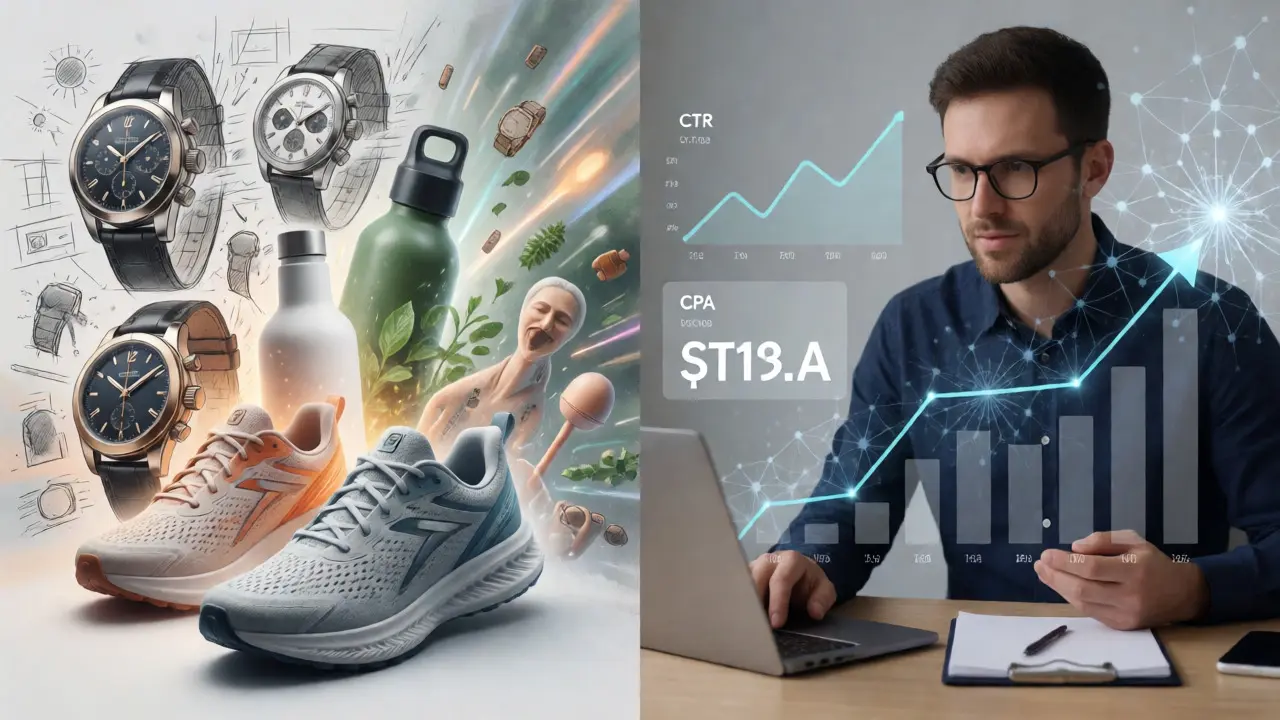
Running ads is only half the battle; analyzing them is the other. ChatGPT can help you interpret performance data if you paste the metrics into the chat. While it won't connect directly to your ad manager API yet, you can copy-paste click-through rates (CTR), conversion rates, and cost-per-acquisition (CPA) numbers along with the ad copy used.
Ask questions like: "Here are two ad variations. Variation A had a CTR of 1.2% and CPA of $15. Variation B had a CTR of 0.8% and CPA of $22. Variation A used a question hook, while B used a statement. Why might A have performed better?" The AI will analyze linguistic patterns and psychological triggers to suggest hypotheses. It might point out that questions engage curiosity gaps more effectively for cold audiences. This speeds up your learning loop significantly.
Common Pitfalls and How to Avoid Them
Do not trust the output blindly. ChatGPT hallucinates facts. If you ask it to cite statistics about your industry, verify them. It might invent a study that doesn't exist. Always cross-reference data points with primary sources.
Another issue is tone drift. If you use the same conversation thread for too long, the AI may lose track of your brand voice. Start new chats for different campaigns or distinct brand voices. Also, be careful with sensitive topics. AI models can inadvertently introduce bias or insensitive phrasing. Always run final copy through a human editor who understands cultural nuances.
Finally, avoid over-reliance. If every ad looks and sounds identical because they all came from the same default prompt settings, your audience will experience banner blindness. Vary your prompts. Change the personas. Challenge the AI to break its own patterns.
Next Steps for Implementation
Start small. Pick one upcoming campaign and use ChatGPT for the initial draft phase only. Measure the time saved versus the editing effort required. Create a library of successful prompts that work for your specific niche. Over time, these become your proprietary assets. Share them with your team to standardize quality.
As you get comfortable, experiment with chaining tasks. Use one prompt to generate ideas, another to refine the best idea, and a third to format it for specific platforms. This modular approach gives you control and reduces errors. Remember, the goal is not to replace human creativity but to amplify it. You bring the strategy and empathy; ChatGPT brings the speed and volume.
Can ChatGPT create complete video scripts?
Yes, it can generate detailed video scripts including scene descriptions, dialogue, and timing cues. However, you should specify the length and platform (e.g., TikTok vs. YouTube) to ensure pacing matches the medium's norms.
Is the content generated by ChatGPT copyright-safe?
Generally, yes. Current legal consensus suggests that AI-generated text lacks copyright protection for the AI itself, meaning you can use it freely. However, always check local regulations and OpenAI's terms of service for commercial usage rights.
How do I stop ChatGPT from sounding robotic?
Provide examples of your existing brand voice. Paste three paragraphs of previous blog posts or emails and ask the AI to mimic that style. Additionally, explicitly instruct it to avoid clichés and corporate jargon.
Can ChatGPT handle multiple languages for global ads?
It supports many languages, but nuance varies. It works well for major languages like Spanish, French, and German. For idioms and cultural references, native speaker review is still essential to avoid awkward translations.
What is the best way to test AI-generated ad copy?
Run split tests against your control group (human-written copy). Track CTR and conversion rates. Do not assume AI copy is better; let the data decide. Often, hybrid approaches (AI draft + human polish) perform best.
I'm Amelia Kensington, a digital marketer located in beautiful Perth, Australia. My love for market research and consumer behavior led me into the fascinating world of marketing. Currently, I lead a team in developing clever and creative marketing strategies for our diverse portfolio of clients. I also love to share my knowledge and passion, so I write about online marketing trends and tips in my free time. One more thing, I don’t just work hard, but play hard too. Adventure and mystery-filled novels keep my weekends occupied and hiking helps keep my spirit free.